
Discourse on the Outer Spheres
Tropical astrology as a system of spiritual cosmology

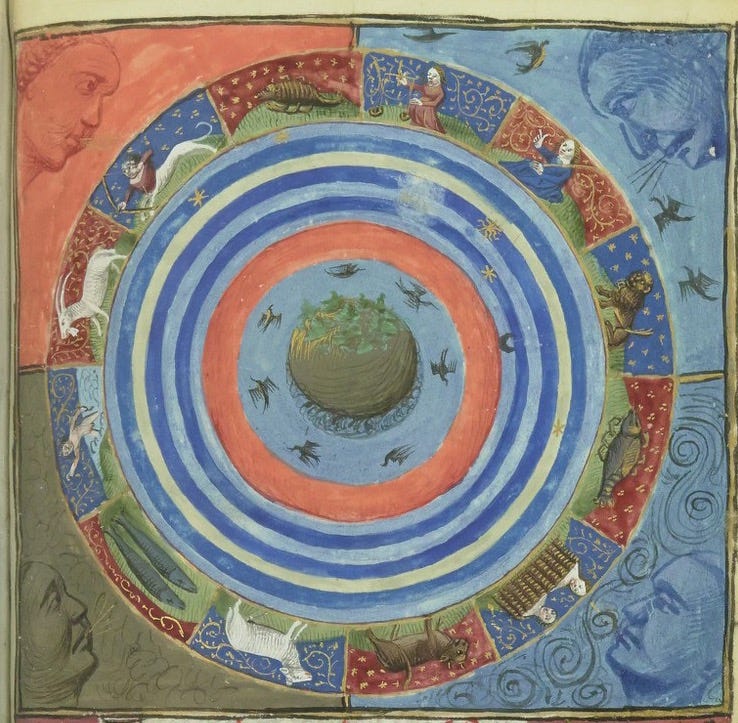
Imagine yourself lying on the ground on a clear starry night staring up at the sky. You know yourself to be at the center of a vast universe. Below you earth and rock, beneath that the underworld, the infernal realm of the dead, accessible through remote caverns at the furthest reaches of the earth. Around you the sea in all directions, because all known land is situated in the center of a vast ocean. Above you the air, the realm of clouds and aerial spirits and beyond that the upper reaches of the realm of the element of fire.
All of this lies in the sublunary world, the elemental realm below the sphere of the Moon, the closest of the celestial spheres. Next lie the nested spheres of all of the rest of the seven planets ranked in ascending order. Mercury, Called by the ancients Stilbon, Venus, likewise known by the ancient name Phosphoros, meaning the light-bearer. The Sun, Helios, shines radiantly in the central orbit, beyond it, Mars, Pyroeis, the star of Ares, and Jupiter, Phaeton. In the farthest reaches of the seventh sphere lies Saturn, the star of Kronos, called Phainon, cold, slow and dark, his dim light shining down from his shadowy sphere near the edge of the cosmos. Beyond the spheres of the planets lie the glittering stars, ancient, possibly eternal, celestial souls illuminated from within by etheric fire. Some of the stars are conventionally visualized arranged in twelve groups known as zoidia, forming the shapes of living things, as animal and human figures, arranged in a narrow belt across the sky, through which the Sun, the planets, and the Moon pass during their journey through the heavens. (Brennan, Chris, Hellenistic Astrology, 166.)
The 8th sphere is called the firmament, the heaven of the so-called fixed stars, those eternal fires “quickened with divine minds”, in the words of the late antique Roman philosopher Macrobius. For many of the philosophers of the ancient world, this was the realm of the gods, the eternal, unchanging, place of archetypal perfection. Here the stars lived their divine life of changeless bliss, beaming their divine effulgence down to the planetary and elemental spheres, and ultimately to the myriad teeming life forms here on Earth. Some philosophers posited a ninth sphere, called the Primum Mobile, beyond which lies the abode of God, who dwells veiled in eternal light, the Empyrean heaven, an idea that would gain traction in the middle ages. Some even extended the number of spheres to ten, separating the sphere of the Primum Mobile from the Empyrean. At any rate, whatever the number of spheres, the orderly motion of the universe, the ancients believed, ultimately derived from God. More poetically, according to Aristotle, the final cause, God in this case, produces motion by being loved (Aristotle, Metaphysics, 1072b). By the whole universe that is. The love of the primum mobile for its source sets the whole cosmos in motion.

Interestingly, and almost unbelievably to us moderns, ancient people believed that the entire heavens rotated around a fixed earth, a motion which created day and night as well as the rising and setting of the stars. As the Hellenistic Egyptian astronomer Claudius Ptolemy, wrote “everything moves from east to west, always at about the same speed.” This is called primary motion or diurnal motion. Secondary motion is the motion of the planets and luminaries, generally from west to east, except when the planets are retrograde. Obviously, at that time, and until the work of Copernicus and Galileo, the true nature of cosmic motion was not understood. And therefore neither were the implications of this true motion, such as the actual cause of retrograde motion in planets: the change in perspective brought on by the Earth’s own revolution around the central Sun. Generations of astronomers had endeavored to explain retrograde motion within the Ptolemaic framework, to “save the phenomena”, as it is called, with the theory of epicycles, in which the planets would occasionally and predictably move backward, against the order of signs, within their perfect spheres. Sadly, with introduction of the heliocentric cosmos and the rotating Earth, the poetic idea of the cosmos moved by divine love and filled with spiritual intelligences, was replaced by an increasingly disenchanted, but astronomically more accurate picture of the cosmos. The first shock to the old world picture, however, had occurred much earlier, and while it largely went unnoticed by all but the greatest minds of the time, it triggered a subtle philosophical shift, and heralded the arrival of a new world age.

In 128 BCE, the astronomer Hipparchus discovered that the vernal point, the place in the ecliptic where the Sun crosses the celestial equator on the Vernal Equinox, no longer corresponded to the stars at the beginning of the constellation Aries, and that the vernal point had drifted into the constellation of Pisces. The repercussions of this discovery were world shattering, though Hipparchus was likely not the first astronomer in history to have noted the slow drift eastward of what they believed to be the sphere of the fixed stars, a gradual change in zodiacal longitude that amounts to about 1 degree every 72 years. The actual cause of the phenomena of precession, the nearly imperceptibly slow wobble of the Earth’s axis of rotation, was as yet unknown to the scientists of the time. Several modern thinkers, notably Giorgio De Santillana and Hertha von Dechen in their fascinating book 1969 book, Hamlet’s Mill, have proposed that the phenomena of precession, and the great cycle of astronomical ages produced by it, were known in very ancient times and that the resulting doctrine was encoded in myths worldwide.
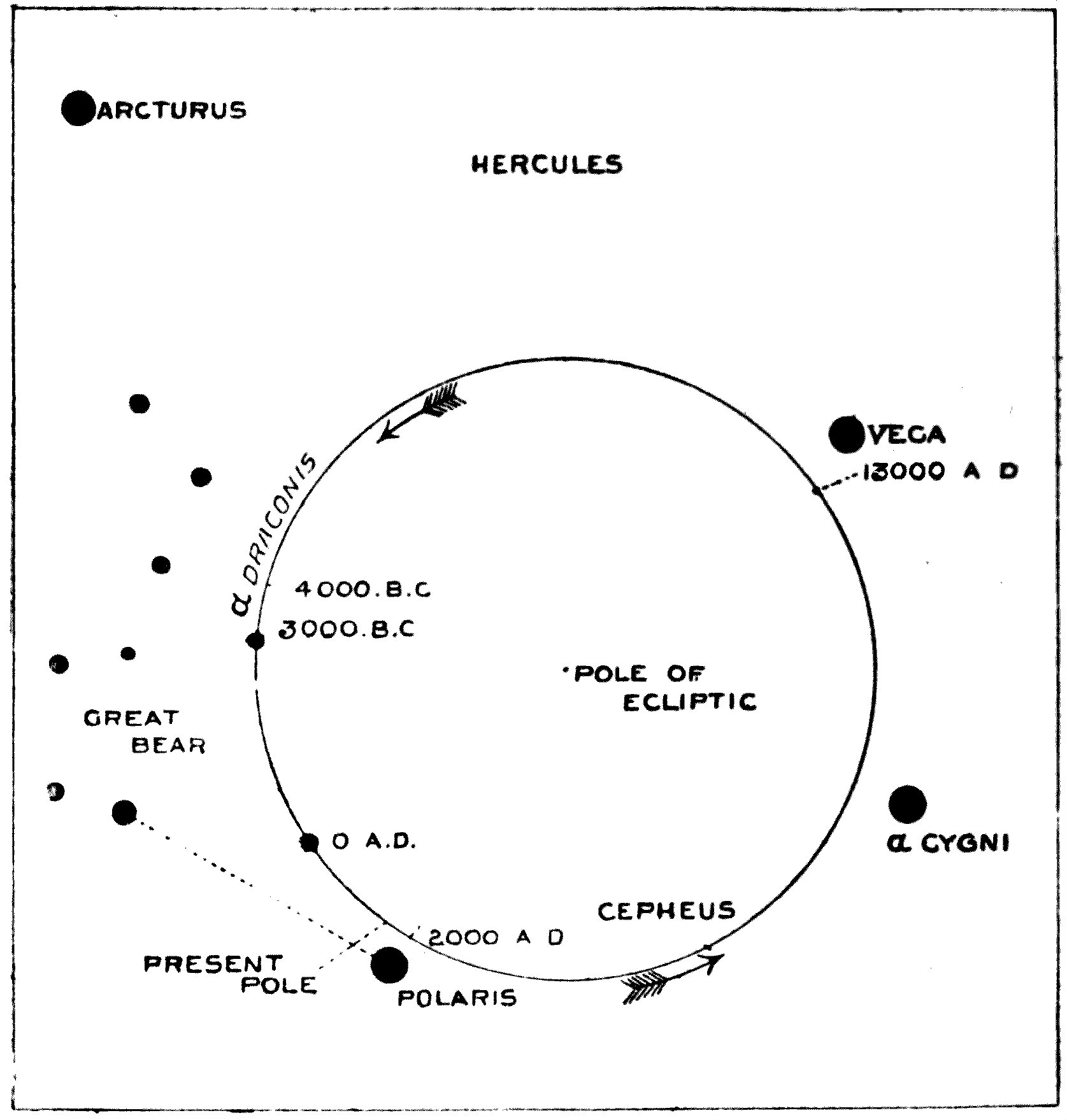
We don’t know if Hipparchus understood the true cause of phenomenon of precession, but we do know that he understood the precession of the equinoxes as being a grand cycle, which has come to be called a Great Year, and that he calculated the length of that cycle to be about 36,000 years, during which time the axial wobble would have brought the vernal point through all of the signs of the Zodiac. The modern figure of the full cycle stands at about 25,676 years and therefore the vernal point spends an average of about 2,140 years in each sign. This is the length of an astrological “age”. The vernal point now stands in late constellational Pisces close to the Aquarius cusp, or having recently entered into Aquarius according to Carl Jung. There is no general consensus among astrologers about the sign boundaries of the constellational zodiac, so the size of the signs, and therefore their cusps vary depending on who is doing the calculation.
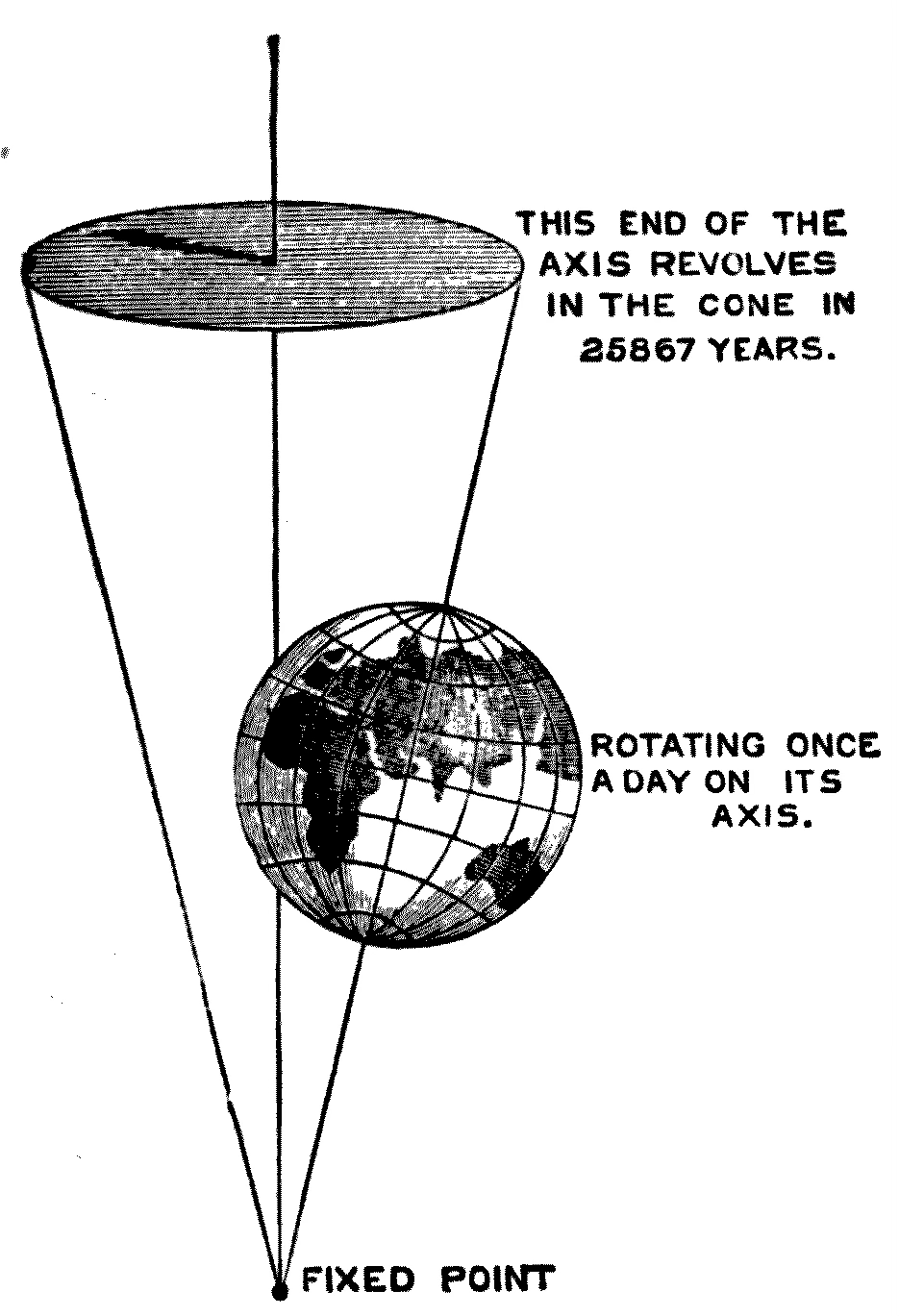
The movement of the Earth’s axis as a result of the precession cycle is no mere shift in the stars, it has major effects on the Earth’s climate by slowly changing the declination of the Sun relative to the Earth’s landmasses and interactions with other astronomical climate rhythms like the perihelion and aphelion cycle caused by the Earth’s elliptical orbit, which currently brings the Earth to its closest point to the Sun on January 3rd, thus moderating winter in the Northern Hemisphere. A small variation in the degree of axial tilt could allow the Sun’s light to strike the Earth’s surface more or less obliquely, resulting in major differences in the amount of solar radiation striking Earth, thus resulting in climate change. The combined effect of the two cycles mentioned here, the precession cycle and the perihelion and aphelion cycle, as well as the addition of the 41,000 year cycle which describes changes in the obliquity, or angularity of the Earth’s axial tilt, all contribute to large scale long term climate mega-cycles known as Milankovitch cycles. (science.nasa.gov Link to read more about Milankovitch cycles here. )
The climate changes caused by the astronomical shifts which coincide with astrological ages could easily have contributed to large-scale cultural, political, and religious change in ancient society of the kinds that may be expected at the end of an astrological age. Please don’t misunderstand me as equating the very man-made climate change we are experiencing now with such cyclical change. Our current climate catastrophe has happened too abruptly and coincides very neatly with increasing atmospheric CO2 levels consistent with 100 years of frantically burning all of the fossil carbon which has been buried in the earth for millions of years. Climate chaos may be the unique signature of the Age of Aquarius, but it has nothing to do with the tilt of the Earth’s axis, or Milankovitch cycles and everything to do with human waste, greed, and shortsightedness.
Because, as Satillana and von Dechen state, “Archaic thought is cosmological first and last”, Hipparchus would have seen precession as a grand cosmic movement, rather than simply a wobble of the Earth on its axis. He would have understood the phenomenon in terms of a movement of the whole cosmos and its discovery would have been a shock to the foundations of the Aristotelian thought that proposed an unchanging eighth sphere composed of the element of aether which neither decays nor changes. As Aristotle himself wrote of the heavens, “whatever is divine, whatever is primary and supreme, is necessarily unchangeable ... .For there is nothing stronger that could move it–since that would mean more divine.” (Aristotle De Caelo, 279a) One would expect that the idea that the realm of the gods could be moved would have been a great moment of ontological shock, at least for the intelligentsia. To educated people, it should have represented an unsettling of the foundations of the traditional understanding, perhaps comparable to the shock the discoveries of Galileo and Copernicus gave to the Renaissance mind. But apparently, that doesn’t seem to have been the case. According to Clemency Montelle, writing in Hellenistic Astronomy, far from being a shocking discovery, “The effects of precession seemed to be poorly understood or deemed irrelevant by later authors; for apart from Ptolemy, it is hardly ever mentioned in the ancient astronomical literature. (C. Montell in Bowen and Rochberg, Hellenistic Astronomy, 23.)Perhaps this lack of enthusiasm about a major scientific discovery was due to the fact that literacy was extremely rare in those days, let alone mathematical and astronomical skill, and therefore most people, wouldn’t have been aware of, or for that matter interested in, precession.
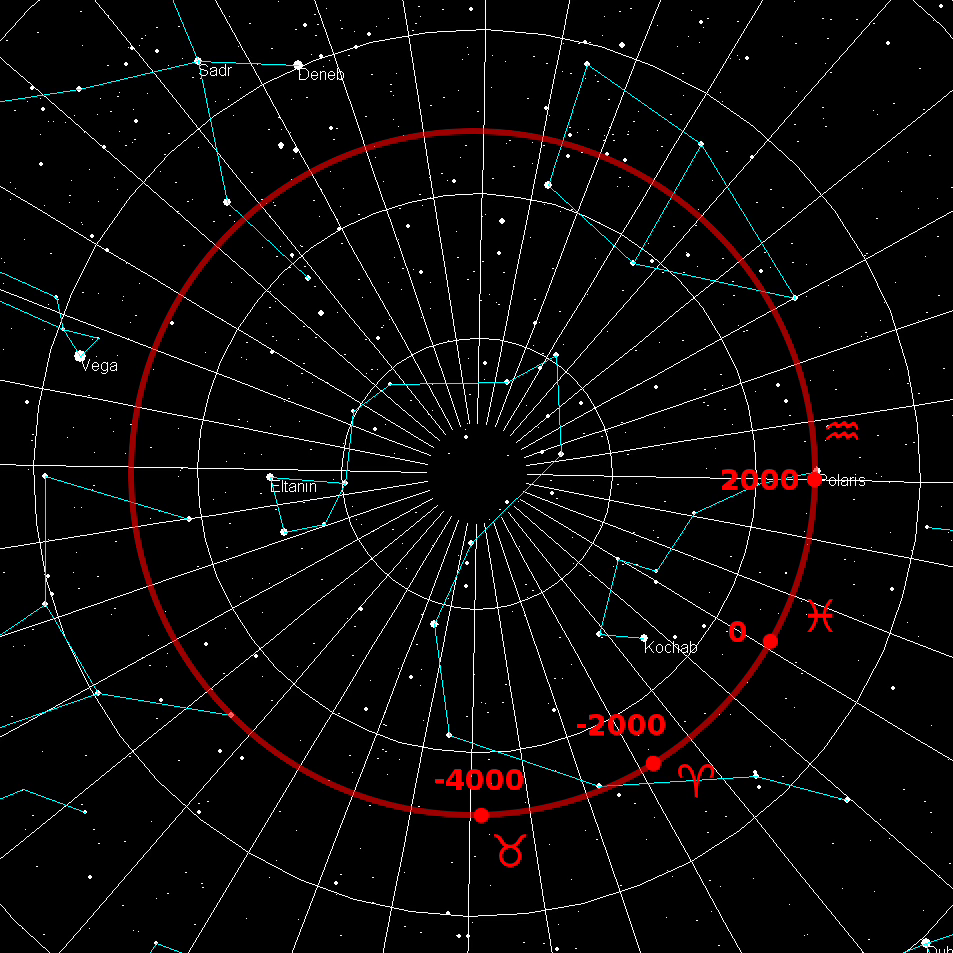
Here I am more interested in another bit of philosophical fallout from the discovery of precession: The development of tropical astrology as a distinct system. As the gap between the so-called fixed stars of the constellation Aries and the equinoctial point which used to be close to the first stars of the sign of Aries widened over the centuries between the development of proto-astrology in Babylon and the discovery of precession by Hipparchus, the developing science of astrology was faced with the choice of whether to adapt the Zodiac to the continually shifting constellational stars, the choice ultimately made by Indian astrology, or to fix the equinoctial point forever at the point where the Sun crossed the ecliptic as 0 degrees Aries, no matter where the stars drifted over the following centuries. It is unclear when exactly the tropical Zodiac was widely adapted by western astrologers, but Ptolemy, writing in the 2nd century A.D. was an enthusiastic proponent.

It seems that at this point it might be helpful to define our terms before we proceed by defining the concept of the three zodiacs. See the illustration above for how they compared in 1524.
The Three Zodiacs:
1. Sidereal: The sidereal Zodiac is based on the twelve constellations of fixed stars of various longitudinal sizes arrayed around the ecliptic. These are the stars we see in the sky, through which the planets, the Sun and the Moon move.
2. Constellational: The constellational zodiac is similar to the tropical, but instead of irregular groups of fixed stars, the constellations are grouped in twelve 30 degree groups, based on the position of the fixed stars.
3. Tropical: The tropical zodiac, simply defined, is based on twelve signs of 30 degrees each, corresponding to the constellations of the same name, equal divisions of the 360 degrees of the ecliptic, beginning at 0° Aries, which is the point at which the Sun crosses the ecliptic on its way north on the spring equinox.
In the second century the Hellenistic Egyptian (Greek speaking and ethnically Greek, but living in Egypt, that is) astronomer and mathematician, Claudius Ptolemy, one of the most influential thinkers of the ancient world, wrote his astrological treatise, the Tetrabiblos, in which he summarized the various elements of system of what we now call Hellenistic astrology, which would become the basis of all subsequent astrology.
Ptolemy, who was familiar with the work of Hipparchus on precession, mentioning it in his treatise on astronomy which is most commonly known by its Arabic title, the Almagest. In his canonical work on astrology, the Tetrabiblos, he clearly bases the zodiacal system he is describing, with its familiar 12 signs which begin with Aries on the spring equinox, on the seasons and the four directions, rather than on the fixed stars he knew to be slowly shifting. After a discussion of the constellations and the powers of the stars which constitute them in chapter 10 of Book I, in chapter 11, Ptolemy clearly states the rationale for beginning the Zodiac at 0 Aries and the beginning of spring, saying that even though the zodiac is a circle and has no beginning, the zodiac should begin at the spring equinox because that time is “also the starting point of them all, making the wet excess of the spring be the initial cause of the zodiac, as though of a living thing, and making the remaining seasons [the causes] for what comes next [in the zodiac]. This is because the first age of all living things, almost like the spring, has a surplus of wetness, being tender and still delicate.” (Ptolemy, Claudius, Tetrabiblos, Book I, 25.)
In the next chapter, while elucidating the powers of the four winds and the four directions, Ptolemy connects them to the Aristotelian concept of elemental qualities, the archetypal powers of heat and cold, wet and dry. These qualities, in various combinations, form the four classical elements so essential to ancient science, medicine, and western esotericism. He distinctly ties the signs of the zodiac to the seasons, the elements, and the regions of the sky the Sun passes through during the four seasons, drawing a comparison between the Sun’s alteration in heat and quality and that of the planets as they pass through the same regions. Both the planets and the signs express heat or coldness, wetness and dryness to varying degrees, and the elemental sympathy between planet and sign forms part of the system of essential dignity still used in traditional astrology today.

*It is important to remember that the “qualities” and elements of ancient science we are discussing here are distinct but related to the physical qualities of the same name.
The division of the signs into elemental triplicities, into air, earth, water, and fire signs, is also based on the elemental qualities, the winds, the directions, and the seasons and has origins in both in the ancient Mesopotamian system of celestial divination from which early astrology derives and in its reception by Greek philosophy. (Rochberg, Francesca, In the Path of the Moon, 47, 48.)In one of the principal surviving texts of Babylonian celestial divination, the Enūma Anu Enlil, which was used as a reference by the Neo-Assyrian court diviners in matters of national security, astral omens, such as lunar eclipses or planetary transits are assigned meaning based on which quarter o the heaven they are seen in. In later texts, such as the cuneiform tablet BM 36746, the relationship between the cardinal direction in which the omen is seen, the zodiacal constellations, and the winds is more explicit, a relationship that is echoed in some of the early authors of Greek astrology, such as Geminus, who credited the Chaldeans, another word for Babylonians, with having invented crucial aspects of the system, such as the correlation of the four winds with the signs of the four triplicities (Rochberg, In the Path of the Moon, 42.). Ptolemy credits the Chaldeans with the system of planetary triplicity rulerships, as well as and the system of subdivisions of the degrees of the signs of the zodiac known as terms. Greek philosophy and mathematics added the four elements and geometrical aspects from their philosophy to the four quadrants, winds and zodiac of 12 signs and 360 degrees of the Babylonians (Rochberg, 3-4.) and the result was the fusion familiar to us today, a system which derives some of its meaning from the quadrants of the world, and some from the elements and the path of the Sun through the zodiac and the seasons, a solar stellar calendar, in other words. Our modern tropical zodiac is a hybrid system for finding divinatory meaning in the movements of the heavens which was bequeathed to us by the sages of antiquity. This gives astrology roots, and brings it down to Earth and finds meaning in the seasonal cycles that we experience in our embodied life.

After the discovery of precession, in order to practice good astrology, or astronomy for that matter, it became necessary to correct the zodiac sign cusps by keeping the Aries point at the point in the sky when the Sun, travelling northward along the ecliptic, crosses the celestial equator and the days are equal worldwide. That requires adjusting that point by moving it backward against the grid of the fixed stars to correct its drift which amounts to about one degree every 72 years or so. The sidereal zodiac requires adjusting in the other direction as far as the equatorial year is concerned. The beginning of constellation Aries may appear somewhat fixed when considered relative to the other stars, but the stars are not only drifting eastward due to the axial wobble, the “motion of the eight sphere” but they are also gradually moving in other directions as well.

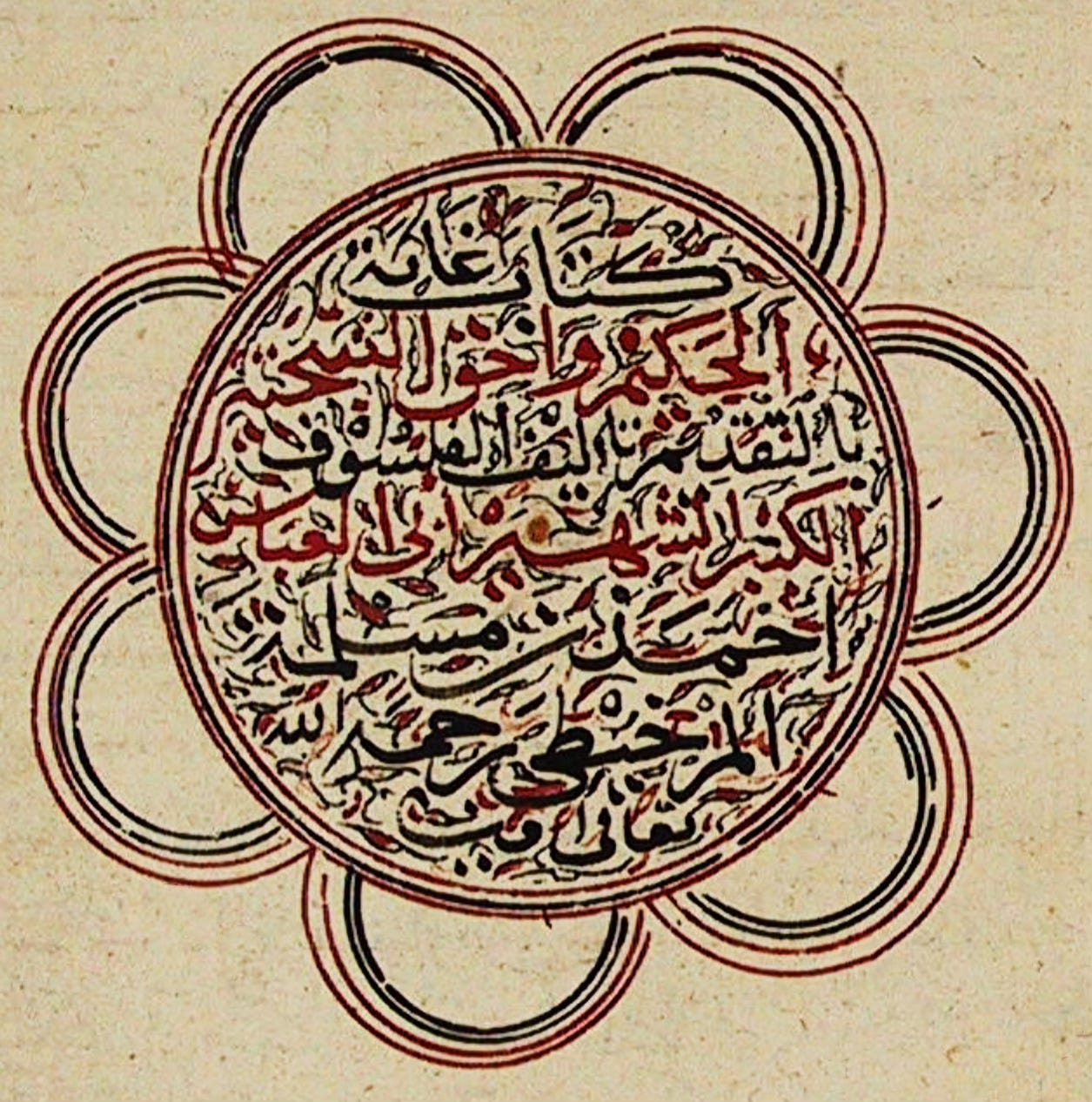
The mysterious author of the Iberian grimoire of astrological magic, the Picatrix (believed by the best current scholarship to be one Maslama Al-Qirtubi, an Iberian alchemist, astrologer, and magician of the 9th century) mentions what he called the “Motion of the Eighth Sphere”, writing that “ancient sages learned in the magical sciences” were aware that the four quarters of heaven were shifting, but they believed the motion was back and forth, eight degrees from west to east for 640 years and the for another 640 they would move eight degrees back from east to west again, an incorrect version of the theory of precession called by ancient astronomers “trepidation”. The astronomers of the time did, however, know that the cause of the motion was a wobble in the earth’s axis, but they just thought it would wobble back the other way rather than making a full rotation. (Al-Qirtubi, Maslama, The Picatrix, Greer and Warnock translation, 77.)
The Picatrix also states that almanac makers often neglected to use the precise figure in their calculations, but the best did. Picatrix says: “You should by no means surrender this [the knowledge and calculations of precession], because it is the greatest foundation of magical knowledge, for by this motion the figures of heaven are changed, which is one of the greatest secrets of our science”, adding that it is proper to attend to this motion in the science of magic as well as the science of the effects of magic.” In other words, it was essential to the proper knowledge of chart calculation, without which astrology and astrological magic is impossible. Remember, astrological magicians in those days had to cast their charts by hand using the most accurate ephemeris they could find, or they would risk performing their operations at the wrong time. “It is proper for you to understand this motion and consider it diligently in every work”, admonishes Al-Qirtubi. Luckily for us we can just use our software that factors in both sets of co-ordinates for its calculations, whether you are a siderealist or a tropicalist. And we can just put away these fruitless debates and not worry about the techniques of other magicians and astrologers and just try to do better, learn more and grow in wisdom. (Al-Qirtubi, Maslama, The Picatrix, Greer and Warnock translation, 77.)
Astrology in India was originally centered on the sidereal nakshatras, also known as the lunar mansions or lunar stations, also known in Arabic as the manzil, an alternate lunar “zodiac” based on the fixed stars passed by the Moon during her orbital cycle of 27 or 28 days. When Hellenistic astrology was brought to India over two millennia ago, the Indian astrologers made a choice to integrate the new system with their ancient system of sidereal nakshatras and the result is the Indian system known as Jyotisha which uses a 12 sign sidereal zodiac, the seven traditional planets, and many of the ancient features of Hellenistic astrology. In this case it was more important for the sages who founded this venerable system to retain the link with the lunar nakshatras and the fixed stars rather than the seasons of far away countries and the elements of Greek philosophy. I confess my lack of knowledge of the Jyotisha beyond what I write here. I am of the opinion that most approaches are valid paths to knowledge and no one system has a monopoly on truth. I have particular respect for the tradition of Jyotisha because it has been a living tradition for millennia, when my own home tradition of Western traditional astrology has had to be reconstructed from pieces by the painstaking work of scholars like so much of the Western esoteric tradition.
There is much common ground between the two approaches. For example, both rely upon the tropical zodiac as a fixed coordinate system, a fact of which I was unaware when I started to research this piece. Tropical astrologers, or rather the astrological software and/or ephemeris they use, need to keep in mind the position of the Aries point in order to calculate the tropical positions of the sign cusps, the planets and fixed stars relative to where they are in the sky astronomically. Similarly, Jyotish astrologers use the ayanamsha, which is the difference in degrees between tropical Aries point and the point degree of the sidereal zodiac at which the Sun crosses the celestial equator on the spring equinox. The two zodiacs are currently about 24 degrees apart. This provides the sidereal zodiac with a needed fixed point for accuracy. The zero Aries point is actually measured by its position relative to very distant fixed stars that change their relative positions extremely slowly. (vedicplanet.com article Ayanamsha Principles link here) The truth is both zodiacs are necessary to the calculations of both schools, which both require fixed coordinates. So, as with so many other debates, the topic itself is a false dichotomy.
Echoing a similar debate in the magical community, the one about the reason magic “works” whether one believes in the so-called spirit model, the psychological model and the energy model. Astrologers sometimes debate the notions of causality in astrology, in other words how does astrology “work”? Are the changes wrought in the material world due to planetary emanations in the form of semi-physical waves or are they due to spiritual forces, called by the Arabic astrologer/magicians ruhaniyyat? Or are they an example of Jungian synchronicities on a grand scale? As with the magical version of the debate, I think the question itself points to the inability of our consciousness to apprehend the problem correctly, and to the concurrent inability of our language to describe it. Likely, all of these positions are woefully inadequate and necessarily metaphorical partial descriptions of a phenomenon which is larger and more complex than our language can describe and our minds can fully understand. Astrological and magical causality will be part astral rays, part astral daimons or ruhaniyyat, part Jungian synchronicity all rolled up into one package.
The stellar rays version of the theory has a lot in its favor, in that there are definite physical energies given off by stars and planets constantly bombarding Earth and all that lives on it at all times. Writing in the 10th century, the extremely influential Islamic thinker Al-Kindi proposed in his aptly titled treatise On the Stellar Rays that the mechanism of action for the changes measured by astrology (and those caused by magic) was the projection of rays. Follow this confusing passage carefully: Al-Kindi writes, “into every place every star pours rays, on account of which, because the diversity of the rays having been blended, as it were, into one, varies the contents of each place, since in each diverse place, the tenor of the ray (which is derived from the harmony of all the stars) is diverse. Beyond this, since it [the harmony] is continually altered according to place by the continuous movement of the planets and the other stars’, the world of the elements and all of its contents are continually moved into diverse conditions” (Al-Kindi, De Radiis Stellarum, Zoller and Hand, 9.) In other words, it is the rays projected from the planets and stars that heat and cool, moisten and dry, (according to the humoral understanding current in ancient science) thus altering the balance of qualities in the elements in terrestrial things, like us.
In a coincidence that was itself something of a synchronicity, I heard this provocative modern restatement of the stellar ray theory today while driving and listening to the audiobook version of paranormal investigator and journalist of the weird, John Keel’s The Eighth Tower:
“In Babylonia, and probably in much earlier cultures, learned men were also aware of the fact that the earth is constantly being bathed in “rays” from outer space and that somehow these rays influence the human condition. They attempted to define this mathematically through the science of astrology. They knew these mysterious rays definitely affected biological organisms, that the rays fluctuated in intensity at different times of the year, and they assumed these rays influenced different people in different ways. By observing the movements of the stars over periods of hundreds of years, they concluded the rays were controlled by such movements. Eventually they went even further, presuming that the positions of the stars at the time of birth had some direct effect on the personalities and lives of individual humans. A large part of that early astrological knowledge is now lost. Modern astrology is based on the fragmented residue of that knowledge.” (Keel, John, The Eighth Tower, 35.)
Despite the fact that I think that the stellar ray theory is only part of what’s going on with the causality of astrology, I couldn’t agree more with Keel’s assessment of the state of the modern remnants of astrology compared with that of the ancients. This isn’t the place to prove it, but it does seem reasonable that much knowledge was lost when western culture rejected much of the so-called pagan knowledge of antiquity (starting with the book burning described in Acts 19:19 and the process discussed in Dryer, A History of Astronomy, 212ff., and a number of other sources) and then during the rise of the scientific worldview what remained was discarded as superstition. Universities stopped teaching astrology, manuscripts were lost due to neglect, and the best minds were no longer attracted to a field that was once prestigious but had become a discredited pseudoscience. During cycles of purgation much knowledge and technique was lost, and we are just now beginning to piece back together the predictive techniques of the ancients. Keel writes, “Modern astrology is merely a corrupted method for translating these influences into humanly acceptable terms. It actually works, but I’m sure it worked much better thousands of years ago because the ancient astrologers somehow knew much more about all this than we do. However, we are relearning now and at a very fast rate.” (Keel, The Eighth Tower, 36.)
Back to stellar rays, by far the most potent source of physical rays in the solar system, far beyond those received from invisible Uranus, Neptune, and Pluto, not to mention dim and distant Saturn, is our own Sun, source of heat and energy for all life on Earth. As Keel puts it, “The sun is pouring forth energy all along the spectrum, from the warming infrared rays to gamma and cosmic rays. We still don’t understand too much about the sun, but we do know that sunspots, or storms on the sun, raise havoc with our communications on all levels, meaning that energies in the VLF and higher radio ranges are also being generated. The earth is sometimes host to mysterious magnetic storms which foul up radio reception, even telephones, and can even produce widespread power failures. The Aurora Borealis, or Northern Lights, seems to be a type of magnetic storm, and this phenomenon is closely allied with sunspot activity.” (Keel, The Eighth Tower, 37.)
The seasonal and diurnal fluctuations of solar energy are the driving force of all of our climactic and biological rhythms. They are the very source of the reflected light from the Moon and all of the other planets. The Sun and its seasonal variations in heat and light are the primary source of meaning in the system of tropical astrology, because the Sun and the rhythms of life on earth far outweigh any of the other radiations from the distant stars. It is for these reasons that one of the greatest minds of the ancient world, Claudius Ptolemy, decided to place the emphasis of the system of astrology he bequeathed to his successors on the solar year and its changes.
But despite the undeniable fact that the Sun is the largest source of energetic radiation in the solar system, the argument for the stellar ray theory is much weaker for the other celestial bodies, with the exception of the Moon, whose gravitational effects on the Earth are beyond dispute. Jupiter, for instance, is probably too distant for measurable physical effects, so spiritual effects beyond physical causality must be postulated to account for the undeniable (to those of us in the know, that is) effects of Jupiter and other even more distant celestial influences in astrological charts. This is even more true of the very distant fixed stars and invisible outer planets. We are in the realm of metaphysics here, not physics, and the explanatory power of materialist science falls short. At this point we have to resort to Jungian synchronicity, which doesn’t really explain anything, but simply says “these two symbolically relevant things happened at the same time and it has to be meaningful” or we’re back to the daimons and ruhaniyyat.
In the latter two positions we confront the great mystery of the actual universe we live in, being a strange and wonderful place where the movements of a star connect to the human lives we live by invisible threads or rather chains. Plotinus wrote “All things must be enchained” when discussing this very topic. Perhaps our ancient predecessors were better able to read the signs than we are because they didn’t have to relearn, as we have, that this world is alive with presence and consciousness, a world of intelligence and purpose, in which the stars, the Sun and the spirits of time and place are linked by silver threads of meaning that are there for the wise to read, if only they know how. That is the faith that keeps me studying, practicing, and reading obscure books written by the scholar/esotericists who have been working hard to uncover lost knowledge and piece together the shattered fragments (often literally) of the ancient wisdom traditions of the world.
In closing: As we have seen, the cosmological system known as tropical astrology is not based on faulty astronomy frozen in time 2000 years in the past, but is actually a sophisticated ancient symbolic system which underlies much of the structure of western occultism. The tropical zodiac links the stars of the heavens with the changes of the seasons in a way that makes it more embodied and connects the heavens with the earth. Astrology, and by extension, ancient science are everywhere in the occult, from the four directions, the seven planets, the four elements, the twelve signs, planetary hours, gods, angels, demons, to the divine names and barbarous words meant to trigger those energies. All of these things presuppose a cosmology which situates one in the imaginal realm, a universe of meaning and intelligence where the magician and diviner, by means of ritual, establishes a two way communication across the realms. It describes a spiritual reality that underlies and shapes the physical one. It is also a model with which to apprehend the somewhat shifting reality of the imaginal world. This cosmology, that of tropical astrology and the modified Ptolemaic universe we have been discussing, like all other esoteric and religious cosmologies, is a map and not the territory described, and as such it must not be literally. But it must be taken seriously.
Thanks for reading!
These posts take days of research and writing in order to get them out to you, so please like, share, and support my work financially if you can by becoming a paid subscriber.
Also Don’t forget, my book The Cunning Farmer: Agrarian Magical Practices, Mythology, and Folklore is due to be released in a few short months, on March 17th, 2026, but you don’t have to wait until then to reserve your copy–follow this link below to preorder today!
Astrology Readings: I am available for natal chart readings and other astrological consultations. I use traditional astrological methods combined with modern planets and a few other modern chart factors that I find interesting. I have studied traditional Renaissance astrology with Christopher Warnock for years and am currently nearing completion of my second course under his instruction. I have also read and studied widely on astrology and other esoteric matters and have a large library of books I use in my consultations. I absolutely eschew the use of AI or software for chart interpretation. Of course, I do use various applications for chart casting, however. I suggest new clients start out with a full natal reading to assess their chart. If you’re interested please reach out by email or via Substack message.
To reach me via email: thecunningfarmer@proton.me
And as always, no AI at all was used to produce this essay.
Bibliography, recommended reading and resources:
(I’m skipping the publication data, contact me if you really need to check my references. Most page numbers are included in in-line citations.)
Macrobius, Commentary on the Dream of Scipio
Aristotle, Metaphysics
- De Caelo
Pseudo Aristotle, De Mundo
Ptolemy, Claudius, Tetrabiblos, Book I, Schmidt trans. and Hand ed.
Al-Kindi, On the Stellar Rays, Zoller, trans. and Hand, ed.
Agrippa, Henry Cornelius, Three Books of Occult Philosophy, Freake, trans. and Tyson, ed.
Brennan, Chris, Hellenistic Astrology: The Study of Fate and Fortune. This book is highly recommended and has a discussion of this entire topic on page 216-222. The author also recently released a podcast episode on the topic as well. Link here.
Giorgi De Santillana and von Dechen, Hertha, Hamlet’s Mill
Bowen, Alan C. and Rochberg, Patricia, Hellenistic Astronomy: The Science in Its Contexts
Rochberg, Francesca, In the Path of the Moon: Babylonian Celestial Divination and Its Legacy
Dryer, J.L.E. A History of Astronomy from Thales to Kepler
Avelar, Helena and Ribeiro, Luis, On the Heavenly Spheres
Keel, John, The Eighth Tower
Al-Qirtubi, Maslama, The Picatrix, Greer and Warnock, trans.
Greer, John Michael, Circles of Power
This is amazing. Quyana, Thank you.
So appreciate the true depth — and breadth — of your historical knowledge. There’s something of the renaissance mind in your writing.